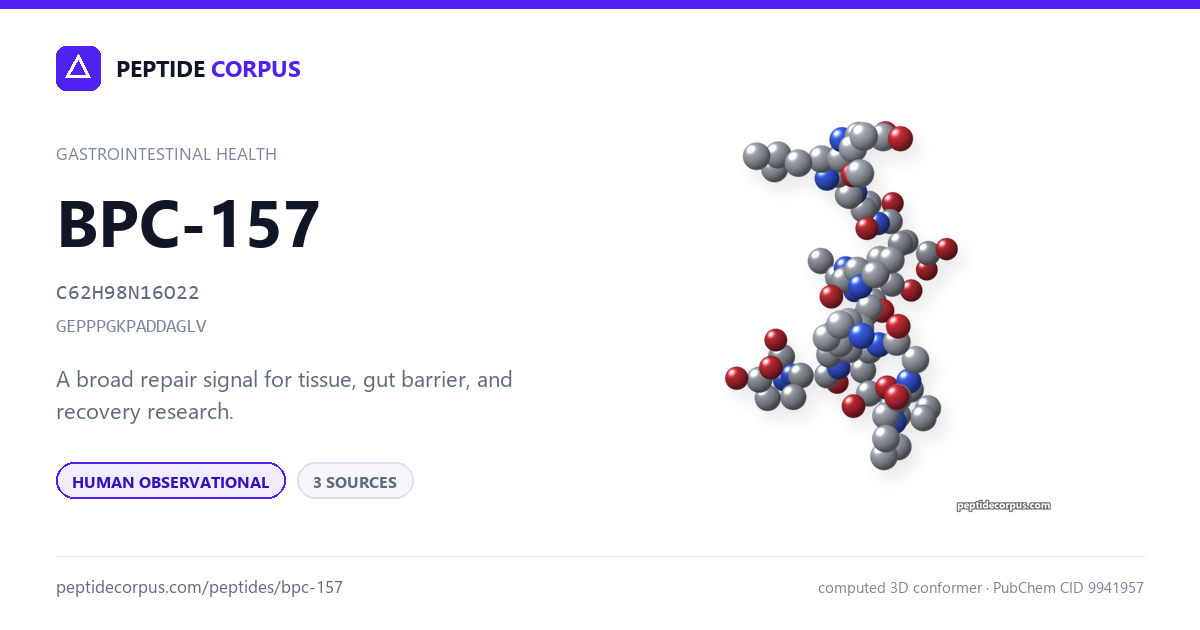
Gastrointestinal Health; Tissue Repair & Regeneration
BPC-157
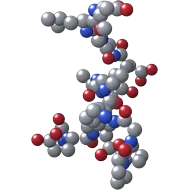
A broad repair signal for tissue, gut barrier, and recovery research.
Last updated
Mechanism
Influences angiogenesis, nitric-oxide signaling, and fibroblast migration.
Reported effects
What sources associate with this compound. Reported categories, not outcomes we have graded — each would need its own citation and rung.
- Systemic repair support
- Gut barrier support
- Tissue regeneration
Dosing on file unverified
250-500 mcg daily, cycled 4–12 weeks
| Reported dose | Volume | Draw |
|---|---|---|
| Low — 250 mcg | 0.25 mL | 25 units |
| High — 500 mcg | 0.5 mL | 50 units |
What that assumes. Assumes 2 mg in 2 mL (1000 mcg/mL) drawn on a U-100 barrel — the preset on this record, not a recommendation and not the only way to mix it. Change the vial mass, the diluent or the barrel and every number in this table changes. Run your own.
Carried from a source that labels it unverified, and reproduced with that label attached. A record of what is reported, not a recommendation. No citation on this page establishes it.
Reconstitution
| Vial | Diluent | Concentration | Typical dose | Draw |
|---|---|---|---|---|
| 2 mg | 2 mL | 1000 mcg/mL | 250 mcg | 25 units |
mass ÷ diluent = concentration; dose ÷ concentration = volume; volume × the syringe factor = units on the barrel (100 for U-100, 40 for U-40). Run your own numbers.
Reported adverse effects
No controlled human safety data exists.
-
Injection site irritation
Literature on file 3
-
human observational
NCT02637284: Phase I, Pilot Study in Healthy Volunteers, to Assess the Safety and Pharmacokinetics of PCO-02, Which Active Ingredient is BPC-157, a Penta-deca-peptide From Gastric Source. graded on: a registered clinical study — “clinicaltrials.gov”
-
animal in vivo
The influence of a novel pentadecapeptide, BPC 157, on NG-nitro-l-arginine methylester and l-arginine effects on stomach mucosa integrity and blood pressure (European Journal of Pharmacology 1997, cited 122x) graded on: an animal model — read from the indexed abstract — “Rats”
Not graded
1 citation whose study design could not be read from the title. Left ungraded rather than guessed at.
- not graded
Identity
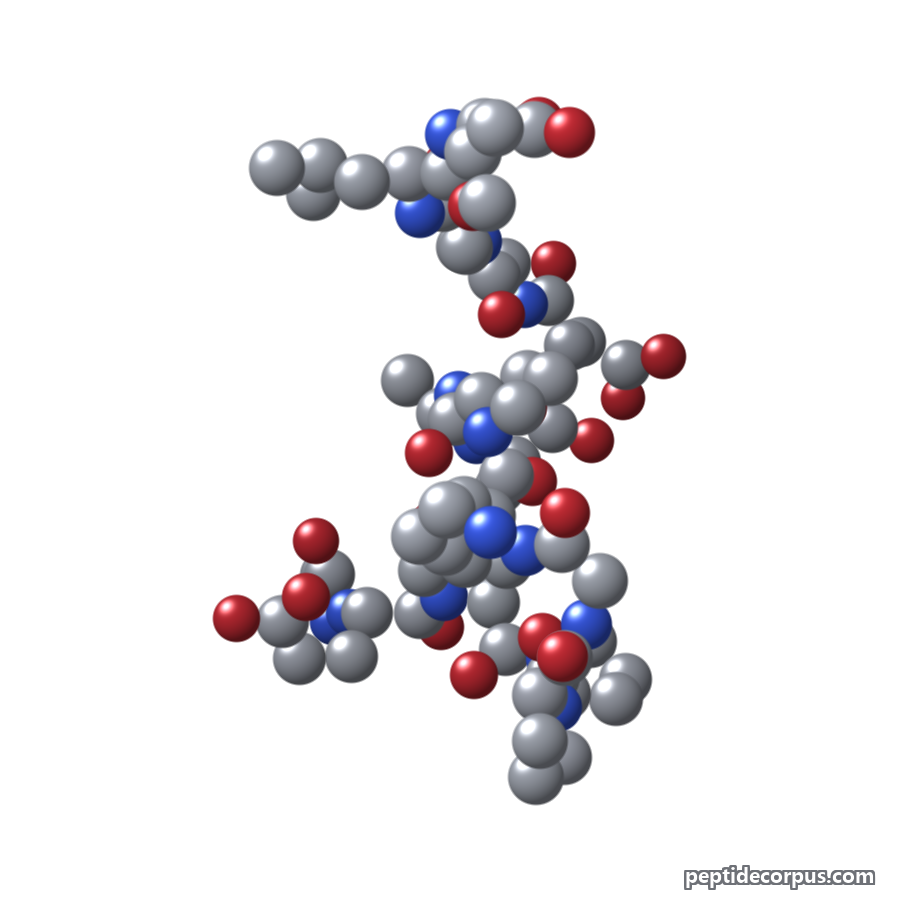
Skeletal formulathe canonical depiction
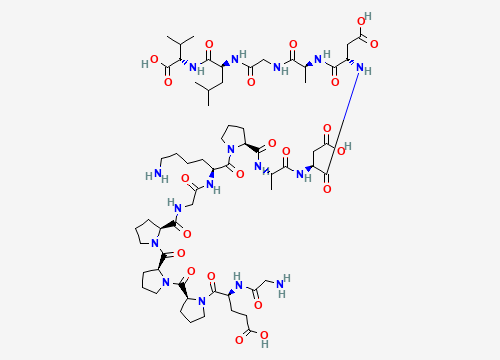
Drawn by PubChem from CID 9941957, the identifier on this record.
- Molecular weight
- 1419.556
- Molecular formula
- C62H98N16O22
- CAS number
- 137525-51-0
- PubChem CID
- 9941957
- InChI key
- HEEWEZGQMLZMFE-RKGINYAYSA-N
- Sequence
- GEPPPGKPADDAGLV
- SMILES
- C[C@@H](C(=O)N[C@@H](CC(=O)O)C(=O)N[C@@H](CC(=O)O)C(=O)N[C@@H](C)C(=O)NCC(=O)N[C@@H](CC(C)C)C(=O)N[C@@H](C(C)C)C(=O)O)NC(=O)[C@@H]1CCCN1C(=O)[C@H](CCCCN)NC(=O)CNC(=O)[C@@H]2CCCN2C(=O)[C@@H]3CCCN3C(=O)[C@@H]4CCCN4C(=O)[C@H](CCC(=O)O)NC(=O)CN
- InChI
- InChI=1S/C62H98N16O22/c1-31(2)25-37(55(92)74-50(32(3)4)62(99)100)71-46(81)29-65-51(88)33(5)67-53(90)38(26-48(84)85)73-54(91)39(27-49(86)87)72-52(89)34(6)68-57(94)41-15-10-21-75(41)58(95)35(13-7-8-20-63)70-45(80)30-66-56(93)40-14-9-22-76(40)60(97)43-17-12-24-78(43)61(98)42-16-11-23-77(42)59(96)36(18-19-47(82)83)69-44(79)28-64/h31-43,50H,7-30,63-64H2,1-6H3,(H,65,88)(H,66,93)(H,67,90)(H,68,94)(H,69,79)(H,70,80)(H,71,81)(H,72,89)(H,73,91)(H,74,92)(H,82,83)(H,84,85)(H,86,87)(H,99,100)/t33-,34-,35-,36-,37-,38-,39-,40-,41-,42-,43-,50-/m0/s1
Classified as
- Nitric Oxide Signalingmechanism
- This mechanism links records that otherwise look unrelated, because cardiovascular, sexual health and wound repair claims all run partly through vessel tone and blood delivery.
- Fibroblast Migrationmechanism
- It is one of the few repair mechanisms with a cheap, clean laboratory readout, which is exactly why so many records here sit on the in_vitro rung and go no higher.
- Angiogenesis Modulationmechanism
- New vessel growth is one of the concrete, measurable steps in the Wound Healing Cascade, so this is where a repair claim can be traced to something specific rather than left as the word healing.
- Gut Barrier Supportmechanism
- This mechanism sits underneath most gut records, and it is one where the measurement problem is as important as the finding. A claim is only as good as the permeability assay behind it.
- Subcutaneousroute
- This is the route the reconstitution arithmetic assumes. Mass divided by diluent volume gives concentration, dose divided by concentration gives volume, and volume in mL multiplied by 100 gives units on a U-100 barrel: 5 mg in 2 mL is 2.5 mg/mL, and 0.25 mg comes out at 0.1 mL, which is 10 units.
- Oralroute
- Route sets what a milligram means. An oral figure and an injected figure for the same compound are not comparable amounts, and treating one as the other is one of the commonest ways a record gets misread.
Also called
- BPC-157
- BPC-157 (GI)
Notes unverified prose
Phase 2 human trial for UC used oral PL 14736 (0.4 mcg & 0.4 mg); small human pilot; NCT02637284; Phase 1; NCT02637284 (safety/PK)
Not on file 0
All 8 tracked fields hold a value on this record: molecular weight and formula, CAS number, PubChem CID, amino-acid sequence, SMILES, InChI and InChI key.
Counted from the record itself, not from what a source said it was missing. 136 of 185 records still have at least one empty.
Share this record