Hormonal & Sexual Health
Kisspeptin-10
An HPG-axis peptide signal for reproductive-hormone research.
Last updated
Mechanism
Stimulates GnRH neurons and pulsatile LH/FSH release.
Reported effects
What sources associate with this compound. Reported categories, not outcomes we have graded — each would need its own citation and rung.
- Libido support
- LH/FSH elevation
- Testicular function
Dosing on file unverified
100-500 mcg 3x/week, cycled 4–8 weeks
| Reported dose | Volume | Draw |
|---|---|---|
| Low — 100 mcg | 0.1 mL | 10 units |
| High — 500 mcg | 0.5 mL | 50 units |
What that assumes. Assumes 2 mg in 2 mL (1000 mcg/mL) drawn on a U-100 barrel — the preset on this record, not a recommendation and not the only way to mix it. Change the vial mass, the diluent or the barrel and every number in this table changes. Run your own.
Carried from a source that labels it unverified, and reproduced with that label attached. A record of what is reported, not a recommendation. No citation on this page establishes it.
Reconstitution
| Vial | Diluent | Concentration | Typical dose | Draw |
|---|---|---|---|---|
| 2 mg | 2 mL | 1000 mcg/mL | 100 mcg | 10 units |
mass ÷ diluent = concentration; dose ÷ concentration = volume; volume × the syringe factor = units on the barrel (100 for U-100, 40 for U-40). Run your own numbers.
Literature on file 3
-
human observational
NCT07224490: Kisspeptin to Quantify GnRH Neuronal Function in Health and Disease graded on: a registered clinical study — “clinicaltrials.gov”
Not graded
2 citations whose study design could not be read from the title. Left ungraded rather than guessed at.
- not graded
- not graded
Identity
Skeletal formulathe canonical depiction
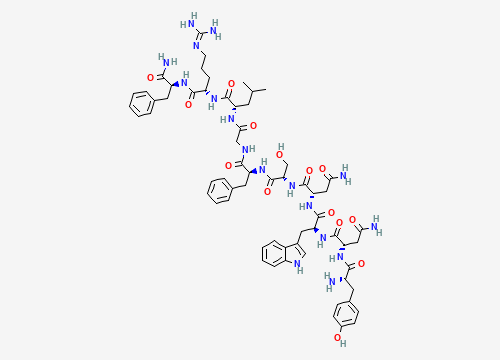
Drawn by PubChem from CID 25240297, the identifier on this record.
- Molecular weight
- 5857
- Molecular formula
- C63H83N17O14
- CAS number
- 374675-21-5
- PubChem CID
- 25240297
- InChI key
- RITKWYDZSSQNJI-INXYWQKQSA-N
- Sequence
- YNWNSFGLRF
- SMILES
- CC(C)C[C@@H](C(=O)N[C@@H](CCCN=C(N)N)C(=O)N[C@@H](CC1=CC=CC=C1)C(=O)N)NC(=O)CNC(=O)[C@H](CC2=CC=CC=C2)NC(=O)[C@H](CO)NC(=O)[C@H](CC(=O)N)NC(=O)[C@H](CC3=CNC4=CC=CC=C43)NC(=O)[C@H](CC(=O)N)NC(=O)[C@H](CC5=CC=C(C=C5)O)N
- InChI
- InChI=1S/C63H83N17O14/c1-34(2)24-45(58(90)74-43(18-11-23-70-63(68)69)57(89)75-44(54(67)86)26-35-12-5-3-6-13-35)73-53(85)32-72-56(88)46(27-36-14-7-4-8-15-36)77-62(94)50(33-81)80-61(93)49(30-52(66)84)79-59(91)47(28-38-31-71-42-17-10-9-16-40(38)42)78-60(92)48(29-51(65)83)76-55(87)41(64)25-37-19-21-39(82)22-20-37/h3-10,12-17,19-22,31,34,41,43-50,71,81-82H,11,18,23-30,32-33,64H2,1-2H3,(H2,65,83)(H2,66,84)(H2,67,86)(H,72,88)(H,73,85)(H,74,90)(H,75,89)(H,76,87)(H,77,94)(H,78,92)(H,79,91)(H,80,93)(H4,68,69,70)/t41-,43-,44-,45-,46-,47-,48-,49-,50-/m0/s1
Classified as
- HPG Axispathway
- The feedback structure is why a record here may report a change in LH or FSH rather than in testosterone, and why those readings can move in opposite directions on the same page.
- Subcutaneousroute
- This is the route the reconstitution arithmetic assumes. Mass divided by diluent volume gives concentration, dose divided by concentration gives volume, and volume in mL multiplied by 100 gives units on a U-100 barrel: 5 mg in 2 mL is 2.5 mg/mL, and 0.25 mg comes out at 0.1 mL, which is 10 units.
- Intravenousroute
- A large share of the pharmacokinetic numbers attached to peptide records, half-life in particular, come from intravenous studies and often from animals. Those numbers describe an intravenous curve and do not transfer unchanged to a depot under the skin.
Also called
- Kisspeptin-10
Notes unverified prose
Multiple Imperial College trials; NCT07224490
Not on file 0
All 8 tracked fields hold a value on this record: molecular weight and formula, CAS number, PubChem CID, amino-acid sequence, SMILES, InChI and InChI key.
Counted from the record itself, not from what a source said it was missing. 136 of 185 records still have at least one empty.
Share this record