Sleep, Mood & Stress
DSIP
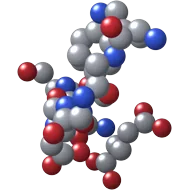
A sleep-onset and circadian-support peptide signal.
Last updated
Mechanism
Modulates sleep-arousal networks through hypothalamic signaling.
Reported effects
What sources associate with this compound. Reported categories, not outcomes we have graded — each would need its own citation and rung.
- Faster sleep onset
- Fewer awakenings
- Sleep continuity
Dosing on file unverified
100-400 mcg daily, cycled 2–4 weeks
| Reported dose | Volume | Draw |
|---|---|---|
| Low — 100 mcg | 0.1 mL | 10 units |
| High — 400 mcg | 0.4 mL | 40 units |
What that assumes. Assumes 2 mg in 2 mL (1000 mcg/mL) drawn on a U-100 barrel — the preset on this record, not a recommendation and not the only way to mix it. Change the vial mass, the diluent or the barrel and every number in this table changes. Run your own.
Carried from a source that labels it unverified, and reproduced with that label attached. A record of what is reported, not a recommendation. No citation on this page establishes it.
Reconstitution
| Vial | Diluent | Concentration | Typical dose | Draw |
|---|---|---|---|---|
| 2 mg | 2 mL | 1000 mcg/mL | 100 mcg | 10 units |
mass ÷ diluent = concentration; dose ÷ concentration = volume; volume × the syringe factor = units on the barrel (100 for U-100, 40 for U-40). Run your own numbers.
Literature on file 6
-
animal in vivo
One-Step Maleimide-Based Dual Functionalization of Protein N-Termini. graded on: an animal model — read from the indexed abstract — “Mice”
Not graded
5 citations whose study design could not be read from the title. Left ungraded rather than guessed at.
- not graded
- not graded
- not graded
- not graded
- not graded
Identity
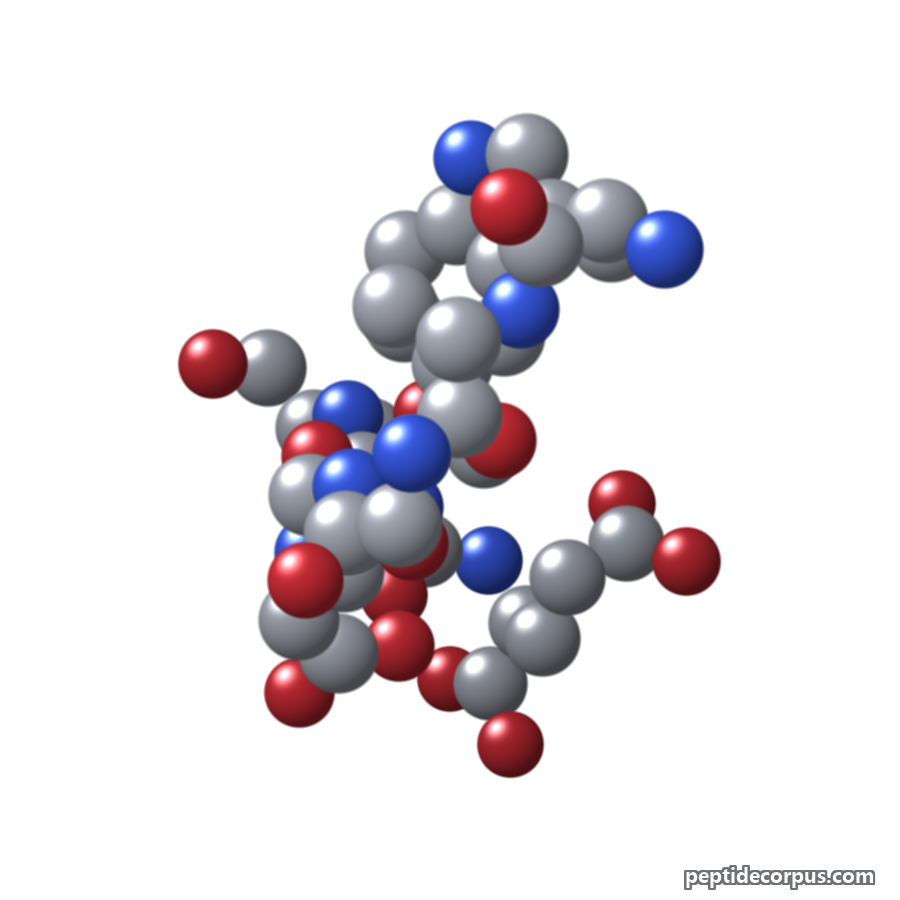
Skeletal formulathe canonical depiction
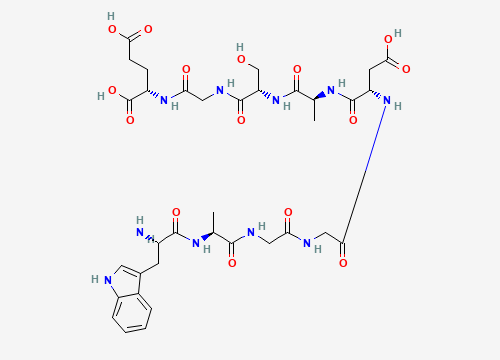
Drawn by PubChem from CID 68816, the identifier on this record.
- Molecular weight
- 848.8
- Molecular formula
- C35H48N10O15
- CAS number
- 62568-57-4
- PubChem CID
- 68816
- InChI key
- ZRZROXNBKJAOKB-GFVHOAGBSA-N
- Sequence
- WAGGDASGE
- SMILES
- C[C@@H](C(=O)NCC(=O)NCC(=O)N[C@@H](CC(=O)O)C(=O)N[C@@H](C)C(=O)N[C@@H](CO)C(=O)NCC(=O)N[C@@H](CCC(=O)O)C(=O)O)NC(=O)[C@H](CC1=CNC2=CC=CC=C21)N
- InChI
- InChI=1S/C35H48N10O15/c1-16(41-32(56)20(36)9-18-11-37-21-6-4-3-5-19(18)21)30(54)39-12-25(47)38-13-26(48)44-23(10-29(52)53)34(58)42-17(2)31(55)45-24(15-46)33(57)40-14-27(49)43-22(35(59)60)7-8-28(50)51/h3-6,11,16-17,20,22-24,37,46H,7-10,12-15,36H2,1-2H3,(H,38,47)(H,39,54)(H,40,57)(H,41,56)(H,42,58)(H,43,49)(H,44,48)(H,45,55)(H,50,51)(H,52,53)(H,59,60)/t16-,17-,20-,22-,23-,24-/m0/s1
Classified as
- Intranasalroute
- A nasal device delivers a fixed volume per spray, so concentration rather than syringe volume sets the amount per spray, and a mass figure on a record is not usable until you know how many actuations it was divided across.
- Intravenousroute
- A large share of the pharmacokinetic numbers attached to peptide records, half-life in particular, come from intravenous studies and often from animals. Those numbers describe an intravenous curve and do not transfer unchanged to a depot under the skin.
Also called
- DSIP
- DSIP (Delta Sleep-Inducing Peptide)
Notes unverified prose
21 human studies (5 RCTs); Schneider-Helmert 1986 study; small placebo-controlled insomnia studies; Schneider-Helmert 1986
Not on file 0
All 8 tracked fields hold a value on this record: molecular weight and formula, CAS number, PubChem CID, amino-acid sequence, SMILES, InChI and InChI key.
Counted from the record itself, not from what a source said it was missing. 136 of 185 records still have at least one empty.
Share this record