Growth Hormone & Performance
GHRP-2
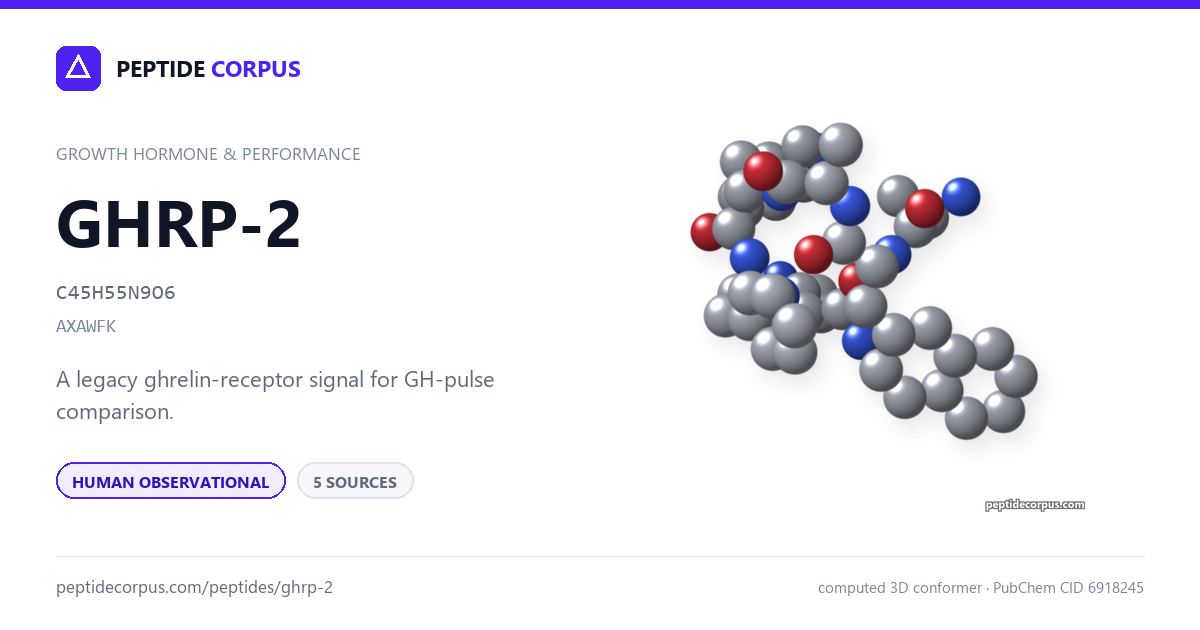
A legacy ghrelin-receptor signal for GH-pulse comparison.
Last updated
Mechanism
GHS-R1a agonist that can raise GH with cortisol/prolactin spillover.
Reported effects
What sources associate with this compound. Reported categories, not outcomes we have graded — each would need its own citation and rung.
- GH pulse amplification
- Appetite stimulation
- Legacy comparator
Dosing on file unverified
100-300 mcg daily, cycled 8–12 weeks
| Reported dose | Volume | Draw |
|---|---|---|
| Low — 100 mcg | 0.1 mL | 10 units |
| High — 300 mcg | 0.3 mL | 30 units |
What that assumes. Assumes 2 mg in 2 mL (1000 mcg/mL) drawn on a U-100 barrel — the preset on this record, not a recommendation and not the only way to mix it. Change the vial mass, the diluent or the barrel and every number in this table changes. Run your own.
Carried from a source that labels it unverified, and reproduced with that label attached. A record of what is reported, not a recommendation. No citation on this page establishes it.
Reconstitution
| Vial | Diluent | Concentration | Typical dose | Draw |
|---|---|---|---|---|
| 2 mg | 2 mL | 1000 mcg/mL | 100 mcg | 10 units |
mass ÷ diluent = concentration; dose ÷ concentration = volume; volume × the syringe factor = units on the barrel (100 for U-100, 40 for U-40). Run your own numbers.
Reported adverse effects
-
Increased appetite
-
Transient cortisol and prolactin elevation at higher doses
Literature on file 5
-
human case series
Pituitary dysfunction in trans-sellar encephalocele: a two-case report and a literature review. graded on: a case report or series — “case report”
-
human observational
Endocrine disorders in pediatric medulloblastoma survivors treated with X-ray or proton beam therapy: a single-institution retrospective study. graded on: an observational human design — “retrospective”
Not graded
3 citations whose study design could not be read from the title. Left ungraded rather than guessed at.
- not graded
- not graded
- not graded
Identity
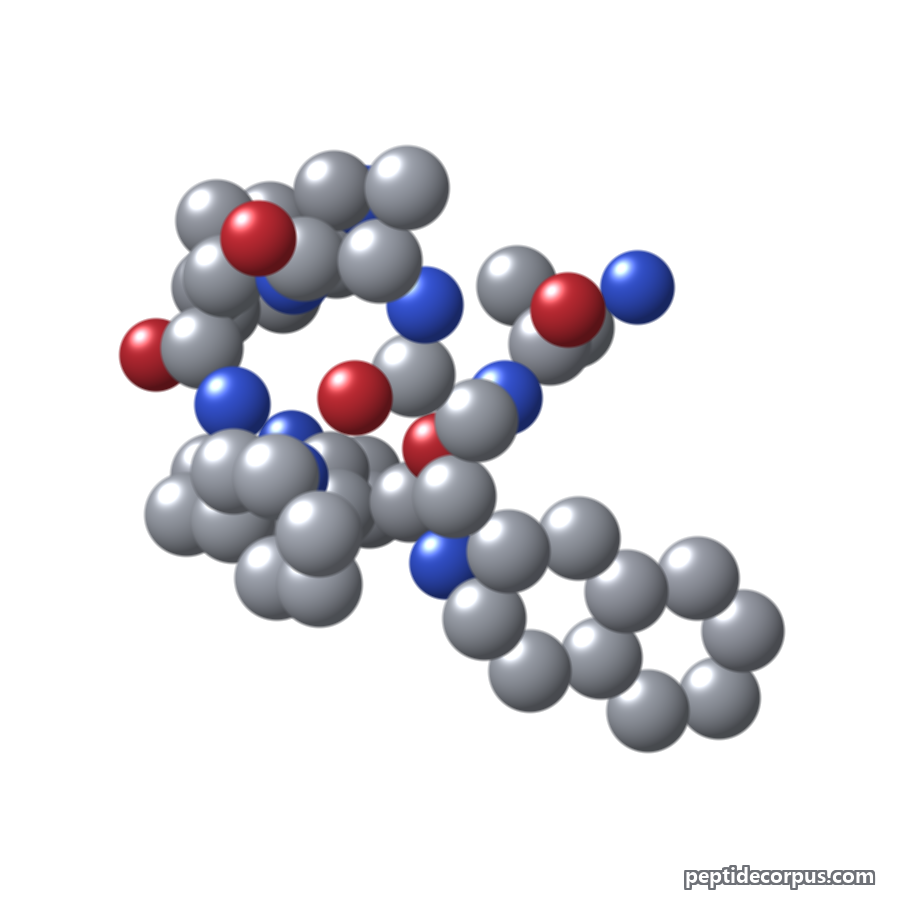
Skeletal formulathe canonical depiction
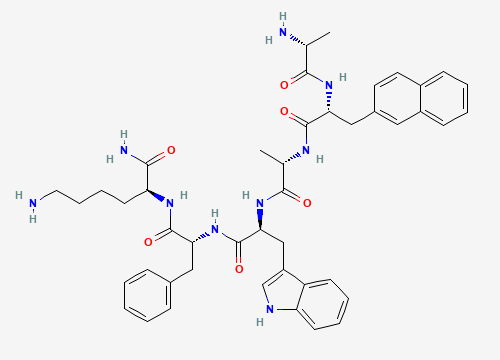
Drawn by PubChem from CID 6918245, the identifier on this record.
- Molecular weight
- 818.0
- Molecular formula
- C45H55N9O6
- CAS number
- 158861-67-7
- PubChem CID
- 6918245
- InChI key
- HRNLPPBUBKMZMT-RDRUQFPZSA-N
- Sequence
- AXAWFK
- SMILES
- C[C@H](C(=O)N[C@H](CC1=CC2=CC=CC=C2C=C1)C(=O)N[C@@H](C)C(=O)N[C@@H](CC3=CNC4=CC=CC=C43)C(=O)N[C@H](CC5=CC=CC=C5)C(=O)N[C@@H](CCCCN)C(=O)N)N
- InChI
- InChI=1S/C45H55N9O6/c1-27(47)41(56)52-38(24-30-19-20-31-14-6-7-15-32(31)22-30)43(58)50-28(2)42(57)53-39(25-33-26-49-35-17-9-8-16-34(33)35)45(60)54-37(23-29-12-4-3-5-13-29)44(59)51-36(40(48)55)18-10-11-21-46/h3-9,12-17,19-20,22,26-28,36-39,49H,10-11,18,21,23-25,46-47H2,1-2H3,(H2,48,55)(H,50,58)(H,51,59)(H,52,56)(H,53,57)(H,54,60)/t27-,28+,36+,37-,38-,39+/m1/s1
Classified as
- Ghrelin Receptor Agonismmechanism
- This is the mechanism behind the compounds usually filed as secretagogues, and it explains why appetite effects appear in the same records as growth hormone effects rather than as an unrelated aside.
- Subcutaneousroute
- This is the route the reconstitution arithmetic assumes. Mass divided by diluent volume gives concentration, dose divided by concentration gives volume, and volume in mL multiplied by 100 gives units on a U-100 barrel: 5 mg in 2 mL is 2.5 mg/mL, and 0.25 mg comes out at 0.1 mL, which is 10 units.
- Intranasalroute
- A nasal device delivers a fixed volume per spray, so concentration rather than syringe volume sets the amount per spray, and a mass figure on a record is not usable until you know how many actuations it was divided across.
- Intravenousroute
- A large share of the pharmacokinetic numbers attached to peptide records, half-life in particular, come from intravenous studies and often from animals. Those numbers describe an intravenous curve and do not transfer unchanged to a depot under the skin.
Also called
- GHRP-2
- Pralmorelin
- growth hormone-releasing peptide-2
- pralmorelinum
Notes unverified prose
Human studies: ; IV 100 mcg diagnostic; SC 1 mcg/kg/h infusion; pediatric SC 0.3-3.0 mcg/kg/day; Human IV/SC infusion studies; diagnostic use
Not on file 0
All 8 tracked fields hold a value on this record: molecular weight and formula, CAS number, PubChem CID, amino-acid sequence, SMILES, InChI and InChI key.
Counted from the record itself, not from what a source said it was missing. 136 of 185 records still have at least one empty.
Share this record