Miscellaneous & Research; Cognitive & Neuroprotection
VIP
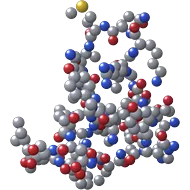
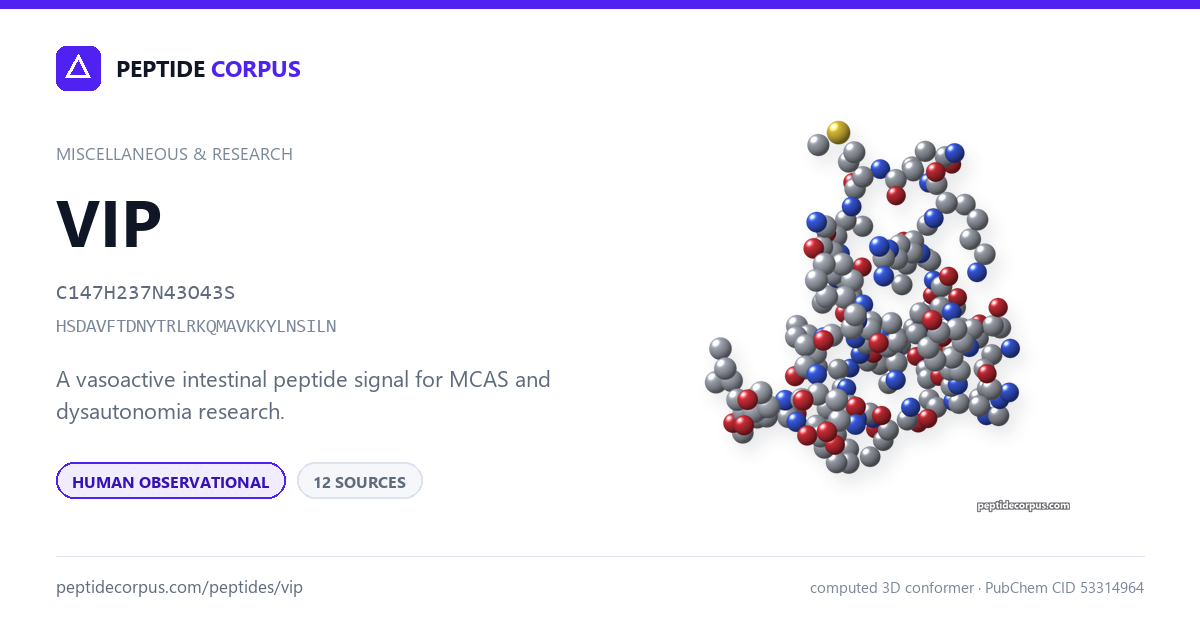
A vasoactive intestinal peptide signal for MCAS and dysautonomia research.
Last updated
Mechanism
VPAC receptor activation associated with anti-inflammatory and mast-cell modulation.
Reported effects
What sources associate with this compound. Reported categories, not outcomes we have graded — each would need its own citation and rung.
- Heat-intolerance support
- Brain-fog reduction
- HRV support
Dosing on file unverified
25-200 mcg daily, cycled 4–12 weeks
Carried from a source that labels it unverified, and reproduced with that label attached. A record of what is reported, not a recommendation. No citation on this page establishes it.
Literature on file 12
-
human observational
NCT00255320: Experimental Headache Induced by Vasoactive Intestinal Peptide graded on: a registered clinical study — “clinicaltrials.gov”
-
human observational
NCT00272896: Hemodynamic and Headache-Inducing Effect of Intravenous Vasoactive Intestinal Peptide (VIP) in Migraineurs graded on: a registered clinical study — “clinicaltrials.gov”
- animal in vivo
-
human observational
Vasoactive intestinal Peptide as a diagnostic or prognostic biomarker in multiple sclerosis: A systematic review. graded on: a synthesis of human studies — “systematic review”
-
animal in vivo
Exploration of the regulatory mechanism of the vasoactive intestinal peptide-eosinophil axis in sheep resistance to Moniezia benedeni infection. graded on: an animal model — “sheep”
-
animal in vivo
GABAergic Signaling from Arginine Vasopressin Neurons in the Suprachiasmatic Nucleus Is Essential for Maintaining the Estrous Cycle in Mice. graded on: an animal model — “Mice”
-
human observational
NCT00004494: Phase I Study of Vasoactive Intestinal Peptide in Patients With Acute Respiratory Distress Syndrome and Sepsis graded on: a registered clinical study — “clinicaltrials.gov”
-
human observational
NCT00464932: Vasoactive Intestinal Peptide in COPD graded on: a registered clinical study — “clinicaltrials.gov”
-
human observational
NCT01471990: The Effect of PACAP38 and VIP on Migraine Patients Assessed by a 3-Tesla MR Scanner graded on: a registered clinical study — “clinicaltrials.gov”
-
human observational
NCT03989817: The Effects of a Long-lasting Infusion of Vasoactive Intestinal Peptide (VIP) on Headache, Cranial Hemodynamic in Healthy Volunteers graded on: a registered clinical study — “clinicaltrials.gov”
Not graded
2 citations whose study design could not be read from the title. Left ungraded rather than guessed at.
- not graded
- not graded
Identity
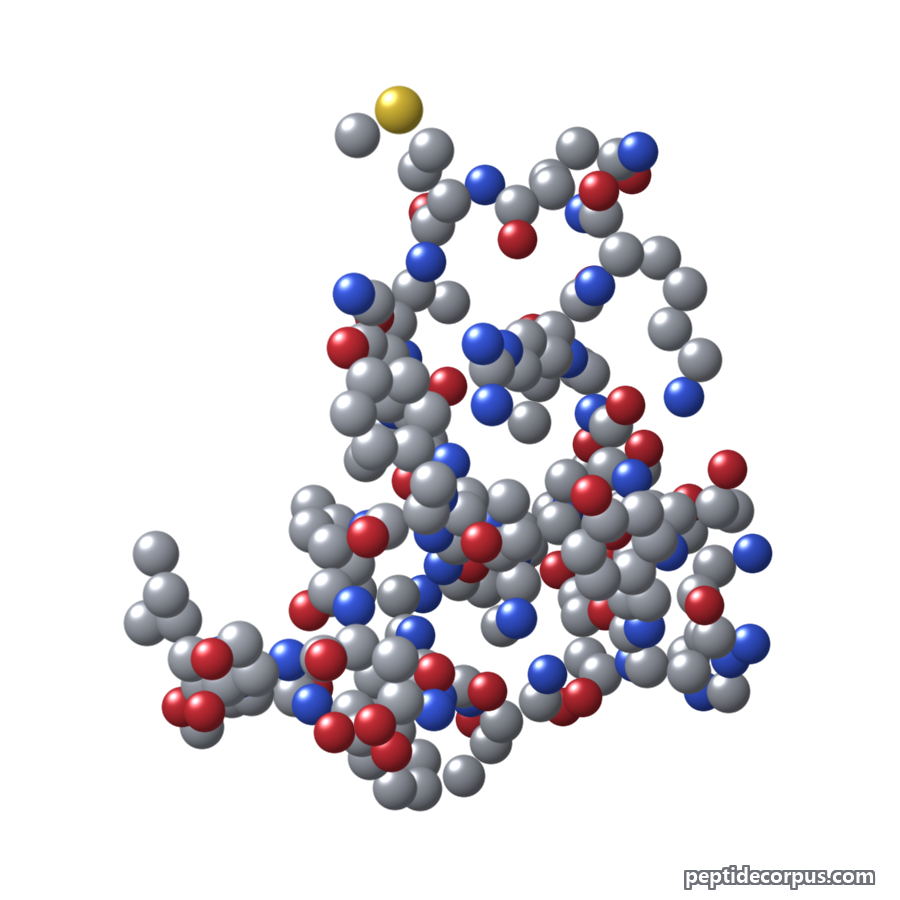
Skeletal formulathe canonical depiction
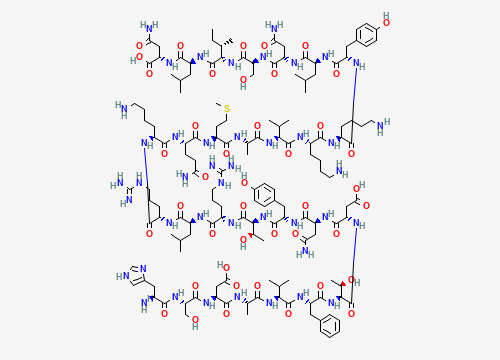
Drawn by PubChem from CID 53314964, the identifier on this record.
- Molecular weight
- 3326.8
- Molecular formula
- C147H237N43O43S
- CAS number
- 37221-79-7
- PubChem CID
- 53314964
- UniProt
- P01282
- InChI key
- VBUWHHLIZKOSMS-RIWXPGAOSA-N
- Sequence
- HSDAVFTDNYTRLRKQMAVKKYLNSILN
- SMILES
- CC[C@H](C)[C@@H](C(=O)N[C@@H](CC(C)C)C(=O)N[C@@H](CC(=O)N)C(=O)O)NC(=O)[C@H](CO)NC(=O)[C@H](CC(=O)N)NC(=O)[C@H](CC(C)C)NC(=O)[C@H](CC1=CC=C(C=C1)O)NC(=O)[C@H](CCCCN)NC(=O)[C@H](CCCCN)NC(=O)[C@H](C(C)C)NC(=O)[C@H](C)NC(=O)[C@H](CCSC)NC(=O)[C@H](CCC(=O)N)NC(=O)[C@H](CCCCN)NC(=O)[C@H](CCCNC(=N)N)NC(=O)[C@H](CC(C)C)NC(=O)[C@H](CCCNC(=N)N)NC(=O)[C@H]([C@@H](C)O)NC(=O)[C@H](CC2=CC=C(C=C2)O)NC(=O)[C@H](CC(=O)N)NC(=O)[C@H](CC(=O)O)NC(=O)[C@H]([C@@H](C)O)NC(=O)[C@H](CC3=CC=CC=C3)NC(=O)[C@H](C(C)C)NC(=O)[C@H](C)NC(=O)[C@H](CC(=O)O)NC(=O)[C@H](CO)NC(=O)[C@H](CC4=CNC=N4)N
- InChI
- InChI=1S/C147H237N43O43S/c1-18-75(12)115(142(229)180-96(56-72(6)7)131(218)183-104(145(232)233)63-110(155)200)188-139(226)106(68-192)185-134(221)101(62-109(154)199)177-130(217)95(55-71(4)5)174-132(219)97(58-81-37-41-84(195)42-38-81)175-125(212)88(33-23-26-49-149)167-123(210)89(34-24-27-50-150)171-140(227)113(73(8)9)186-118(205)76(13)164-121(208)93(47-53-234-17)170-127(214)92(45-46-107(152)197)169-122(209)87(32-22-25-48-148)166-124(211)90(35-28-51-161-146(156)157)168-129(216)94(54-70(2)3)173-126(213)91(36-29-52-162-147(158)159)172-143(230)116(78(15)193)189-136(223)98(59-82-39-43-85(196)44-40-82)176-133(220)100(61-108(153)198)178-135(222)103(65-112(203)204)182-144(231)117(79(16)194)190-137(224)99(57-80-30-20-19-21-31-80)181-141(228)114(74(10)11)187-119(206)77(14)165-128(215)102(64-111(201)202)179-138(225)105(67-191)184-120(207)86(151)60-83-66-160-69-163-83/h19-21,30-31,37-44,66,69-79,86-106,113-117,191-196H,18,22-29,32-36,45-65,67-68,148-151H2,1-17H3,(H2,152,197)(H2,153,198)(H2,154,199)(H2,155,200)(H,160,163)(H,164,208)(H,165,215)(H,166,211)(H,167,210)(H,168,216)(H,169,209)(H,170,214)(H,171,227)(H,172,230)(H,173,213)(H,174,219)(H,175,212)(H,176,220)(H,177,217)(H,178,222)(H,179,225)(H,180,229)(H,181,228)(H,182,231)(H,183,218)(H,184,207)(H,185,221)(H,186,205)(H,187,206)(H,188,226)(H,189,223)(H,190,224)(H,201,202)(H,203,204)(H,232,233)(H4,156,157,161)(H4,158,159,162)/t75-,76-,77-,78+,79+,86-,87-,88-,89-,90-,91-,92-,93-,94-,95-,96-,97-,98-,99-,100-,101-,102-,103-,104-,105-,106-,113-,114-,115-,116-,117-/m0/s1
Classified as
- Subcutaneousroute
- This is the route the reconstitution arithmetic assumes. Mass divided by diluent volume gives concentration, dose divided by concentration gives volume, and volume in mL multiplied by 100 gives units on a U-100 barrel: 5 mg in 2 mL is 2.5 mg/mL, and 0.25 mg comes out at 0.1 mL, which is 10 units.
- Intranasalroute
- A nasal device delivers a fixed volume per spray, so concentration rather than syringe volume sets the amount per spray, and a mass figure on a record is not usable until you know how many actuations it was divided across.
- Intravenousroute
- A large share of the pharmacokinetic numbers attached to peptide records, half-life in particular, come from intravenous studies and often from animals. Those numbers describe an intravenous curve and do not transfer unchanged to a depot under the skin.
Also called
- VIP
- VIP (Vasoactive Intestinal Peptide) (Research)
- Vasoactive Intestinal Peptide (VIP)
Notes unverified prose
NCT00255320: 8 pmol/kg/min IV; Phase I ARDS; NCT00255320: 8 pmol/kg/min IV over 25 min; Phase I ARDS: dose escalation IV over 6-12h; NCT00255320; NCT00272896
Not on file 0
All 8 tracked fields hold a value on this record: molecular weight and formula, CAS number, PubChem CID, amino-acid sequence, SMILES, InChI and InChI key.
Counted from the record itself, not from what a source said it was missing. 136 of 185 records still have at least one empty.
Share this record